Longevity as a Circular Strategy Design Conformity Circular Champions | KI Europe
LONGEVITY AS A CIRCULAR STRATEGY
KI EUROPE

June 17, 2026
Olivia Aspinall
5 LESSONS IN CIRCULAR LEADERSHIP FROM KI EUROPE
In collaboration with Design Conformity, I am interviewing leaders, change-makers and mentors within the world of sustainable design.
For this conversation, I spoke with Jeremy and Nicole from KI Europe, a global furniture manufacturer specialising in commercial workplace, education and healthcare environments. Together, they bring perspectives from across the business, offering insight into how sustainability is understood, communicated and implemented within a large-scale organisation.
Rather than positioning circularity as something new or disruptive, their approach focused on longevity, simplicity and making products that work within the realities of the systems they sit in.
At a time where conversations around sustainability can be derailed by a focus on innovation or new materials, KI’s perspective was a reminder that one of the most effective strategies is often the simplest, making products that last.
1 – THE MOST SUSTAINABLE PRODUCT IS THE ONE THAT LASTS
A key theme throughout the conversation was durability. For KI, sustainability isn’t about reinventing products, but about designing them to perform really well over long periods of time, reducing the need for replacements.
This is particularly relevant in sectors such as education and healthcare, where furniture is used intensively and expected to withstand years of use. Designing for longevity becomes a practical and effective way to reduce environmental impact and adhere to the circular principle of keeping products in circulation for as long as possible.
This approach challenges the idea that sustainability must always come from newness or innovation. Instead, it suggests that designing for durability can be one of the most straightforward and impactful circular strategies.
2 – MATERIAL PERFORMANCE MATTERS MORE THAN PERCEPTION
There is often a gap between how materials are perceived and how they actually perform. In particular, plastic is often viewed negatively, largely due to its association with single-use products and waste.
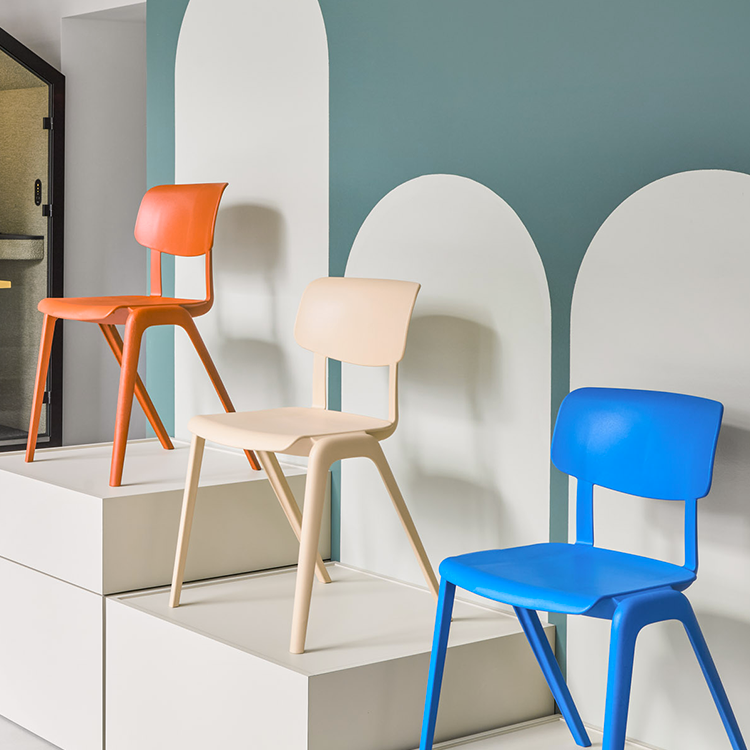
However, this perception does not always reflect how materials function within a product system. In KI’s case, plastic is used to create highly durable, single-piece products, designed to withstand intensive use over long periods of time. You can see this evident in all their one piece chairs, such as the Sutton, Sebel, Postura and and Hatton.
By using a single-piece, injection-moulded structure, the chair eliminates the need for multiple components, fixings or mixed materials. This not only increases strength and longevity, but also simplifies its end-of-life pathway. The chair can be easily identified, processed and recycled without the need for disassembly, supporting a much clearer circular route.
The material itself also supports this system. Polypropylene allows for durability, flexibility and resistance to wear, while also enabling the use of recycled content and full recyclability at end of life. All KI’s polypropylene chairs are PP-marked, making them easy to identify and recycle at end of life.
The challenge, therefore, is not just about material selection, but about reframing how materials are understood. Moving away from a blanket view of good or bad materials towards a more nuanced understanding of how they are used, how long they last, and what happens to them at the end of their life.
This highlights a broader issue within the industry, where decisions can sometimes be driven more by perception than performance. Bridging this gap is key to making more informed and effective material choices.
3 – CIRCULARITY IS CONSTRAINED BY REAL WORLD LOGISTICS
While circular design principles often focus on ideal systems of reuse and closed-loop recycling, the reality is that these systems must operate within practical constraints.
Circularity is not always as straightforward as designing products to be recyclable or reusable.
The logistics of collection, transportation and processing play a significant role in determining whether a solution is truly effective.
In the case of durable products with long lifespans, such as KI’s seating, if an item is to fail and need repair or takeback it is more likely to be a single item, rather than in bulk. This makes take-back schemes or closed-loop systems often difficult to implement in a way that can be environmentally and economically viable, unless significant volumes of product are available for collection from each site.
When chairs like KI’s are designed as life-long products, the best option for recycling is more likely to be open-loop recycling. This is where materials are processed through existing, large-scale recycling systems.
This highlights a broader lesson within circular design, that solutions must be evaluated not just on intent, but on how they function in practice. Understanding the full system, including logistics, infrastructure and scale, is essential in developing approaches that are both effective and achievable.
4 – SUSTAINABILITY AND PROFITABILITY DO NOT HAVE TO BE IN CONFLICT
Sustainability should not be viewed as a trade-off against business performance. Instead, it is increasingly becoming a fundamental part of how a successful and resilient business operates.
Rather than treating environmental considerations as an additional burden, KI’s approach is to integrate them into the core of their product development and decision-making processes. This reflects a broader shift in thinking, where sustainability is not separate from commercial success, but directly linked to it.
By anticipating changes in regulation, customer expectations and industry standards, sustainability becomes part of long-term business strategy. It is not just about responding to current demands, but about preparing for what will be required in the future.
This perspective challenges the idea that more sustainable products must come at a premium. Instead, it positions sustainability as something that, when approached effectively, supports both environmental and business outcomes.
5 – PROVE SUSTAINABILITY THOUGH PERFORMANCE
Sustainability at KI is not positioned as a standalone initiative, but embedded within how products are designed, tested and guaranteed over time.
Across their range, this is reflected in long-term warranties, with many products designed to last decades and backed by guarantees of 20 years or more.
This approach moves beyond sustainability as a message and instead demonstrates it through product performance. Designing furniture that remains in use for extended periods, reduces the need for replacement and supports the circular principle of keeping products in circulation for as long as possible.
Rather than relying on a single innovation or claim, this reflects a consistent, long-term approach, where durability, material responsibility and product longevity combine to deliver meaningful impact at scale.
KI’s approach to sustainability and circularity is clear and transparent. Rather than positioning circularity as something abstract or idealised, their focus remains on what works in practice; designing durable products, making informed material choices and communicating sustainability in a way that is accessible and honest.
There is a clear consistency between what is designed, how it is communicated and how it performs in use. This alignment reflects a deeper understanding that circularity is not achieved through a single innovation, but through a series of considered decisions made across the product lifecycle.
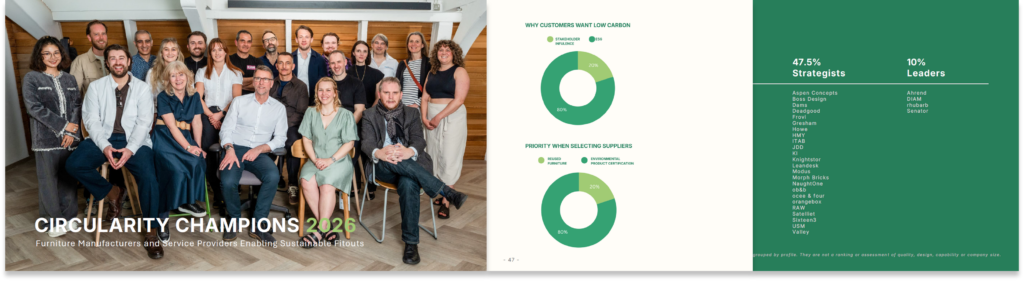
In this sense, KI’s approach highlights that progress does not always come from entirely new solutions, but from applying existing principles more effectively. By focusing on longevity, simplicity and clarity, they offer a grounded and realistic perspective on how circular design can be implemented at scale. To find our more about our Circular Champions, read our 2026 report below: