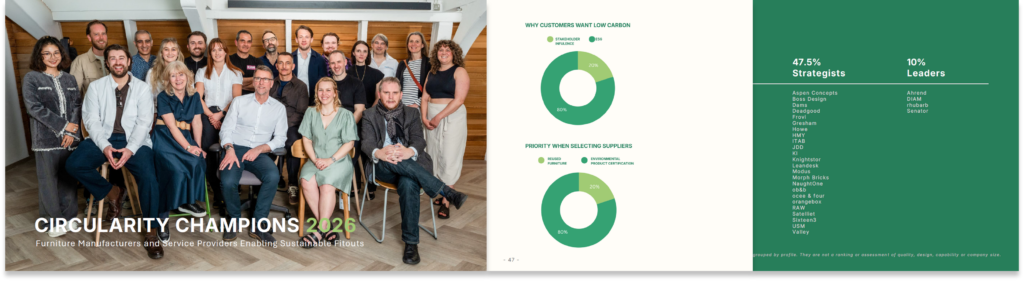
Keeping Value Alive. Design Conformity Circular Champions | Joanna Knight
KEEPING VALUE ALIVE
JOANNA KNIGHT

June 17, 2026
Olivia Aspinall
5 LESSONS IN CIRCULAR LEADERSHIP FROM JOANNA
In collaboration with Design Conformity, I am interviewing leaders, change-makers and mentors within the world of sustainable design.
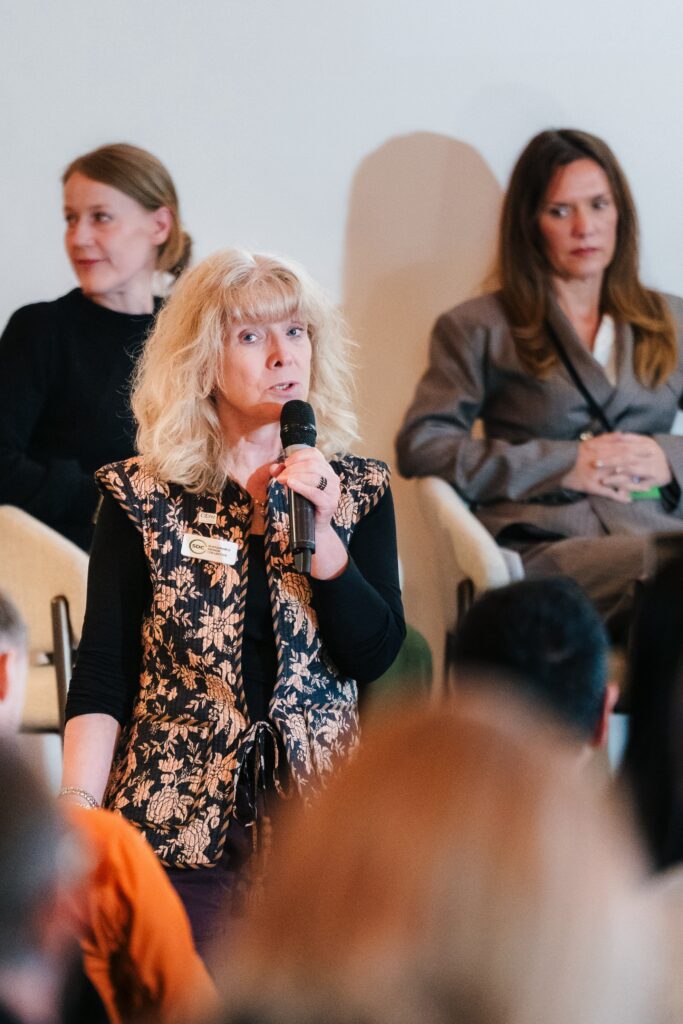
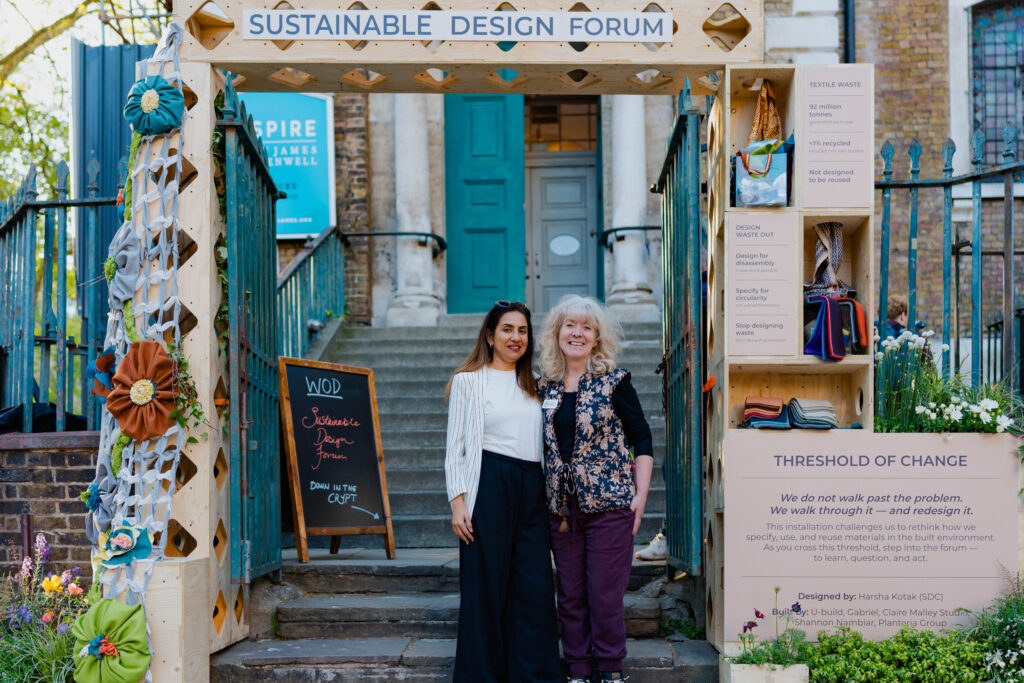
Joanna Knight has spent more than 35 years working within the furniture and interiors sector, witnessing first-hand how sustainability has evolved from a niche conversation into a business priority. Today she works as an independent sustainability consultant, co-founder of the Sustainable Design Collective and Sustainability Lead at Ocee & Four Design and Southerns Broadstock Interiors, while also holding a number of influential industry positions.
Appointed as a Fellow of the Institute of Sustainability and Environmental Professionals (ISEP) and awarded Chartered Environmentalist status, Joanna’s contribution to sustainability has been formally recognised by her peers. Throughout our conversation, she spoke candidly about the challenges facing the industry, drawing on decades of experience to question assumptions, challenge accepted thinking and advocate for a more practical approach to circularity.
Rather than searching for simple solutions, Joanna’s perspective centres on understanding systems, valuing resources and asking better questions about the choices we make.
1 – SUSTAINABILITY IS ABOUT STORY TELLING AS MUCH AS IT IS ABOUT DATA
Joanna’s career began in marketing and communications, a background that continues to shape how she approaches sustainability today.
While environmental data, carbon measurements and lifecycle assessments are all important, she believes they only become valuable when people can understand them.
The challenge is not simply gathering information, but translating complexity into language that enables better decisions. Without that translation, sustainability risks becoming inaccessible, overwhelming or disconnected from the people expected to act on it.
Joanna has focused on helping organisations communicate environmental issues in ways that engage people rather than alienate them. In many cases, it is the story behind a product, material or decision that creates understanding, not the data behind it.
Progress within circular design depends not only on technical expertise, but also on our ability to communicate ideas clearly and bring others along with us.
2 – RESOURCE EFFICIENCY IS THE FOUNDATION OF SUSTAINABILITY
Sustainability begins with valuing the resources we already have.
While environmental conversations often focus on embodied carbon, materials or emerging technologies, Joanna believes the bigger challenge is how quickly we discard products that still have value. Regardless of whether a product is made from timber, steel, plastic or a bio-based alternative, the environmental benefits are quickly eroded if it is treated as disposable.
This perspective is shaped by more than 35 years in the furniture industry. Joanna has witnessed a significant shift in attitudes towards ownership and resource use. Earlier in her career, organisations would routinely relocate furniture when moving offices, extending product lifespans through practicality as much as necessity. Today, many organisations find it easier and cheaper to replace furniture altogether, even when products remain perfectly functional.
Having been involved in furniture lifecycle management, remanufacturing and reuse since the early 2000s, Joanna has seen first-hand how much value can be retained when products are viewed as assets rather than consumables. Resource efficiency sits at the heart of sustainability. The most sustainable product is not a new product at all.
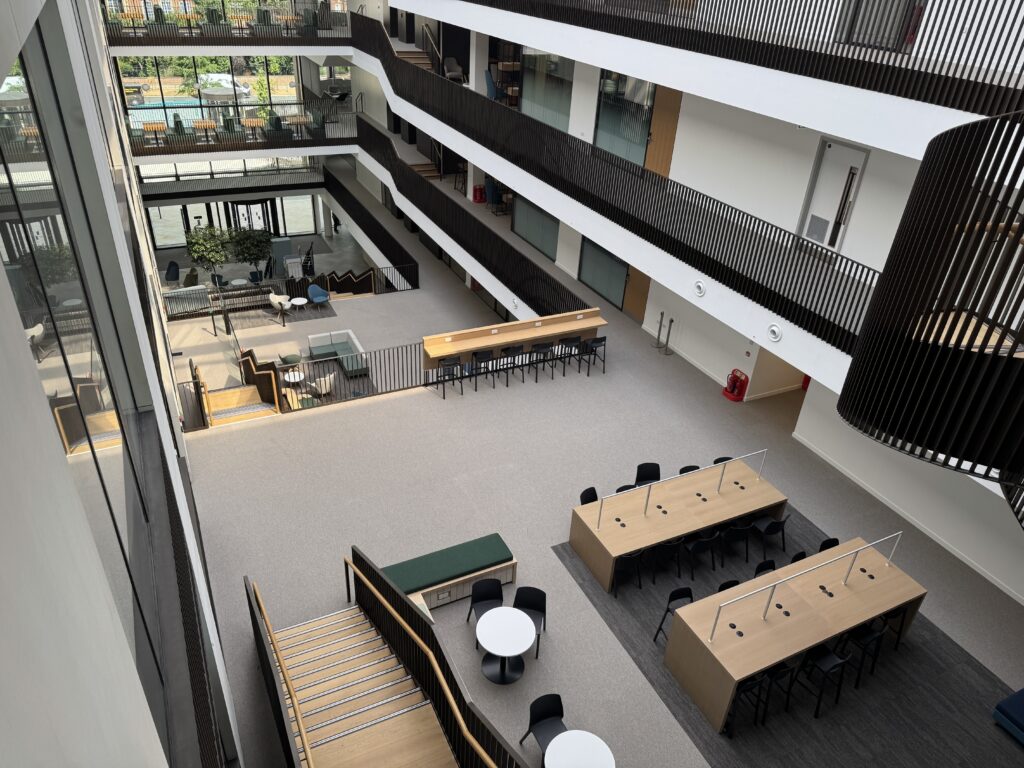
A recent project for the University of Oxford’s Life and Mind Building brought this thinking to life. Rather than beginning with a specification for entirely new furniture, the team, including colleagues at Southerns Broadstock Interiors, started by carrying out a detailed audit of the furniture already owned by the university. The challenge then became understanding how existing products could be retained, reused and integrated into the new building. The solution was based on outcomes and the overall design intent. By utilising existing furniture within back of house areas, budget was available to purchase better made and longer lasting furniture for the collaborative, open plan spaces.
Sustainable Development Goal 12, Responsible Consumption and Production, remains one of the most important sustainability objectives. If we can become better at valuing materials, retaining products and reducing unnecessary waste, many of the environmental challenges the industry is trying to solve become significantly easier to address.
“Ultimately, it’s about reducing waste and maximising resource efficiency.”
3 – WASTE IS TOO CHEAP
Waste is often the cheapest option. Over several decades, she has watched increasing pressure on cost drive purchasing decisions across the furniture industry. Furniture has become cheaper to buy, disposal remains relatively inexpensive, and replacement is often seen as the simplest solution. Yet the true value of a product extends far beyond its purchase price.
The issue extends beyond economics. When disposal becomes the easiest and most affordable option, it can create a disconnect between organisations and the resources they consume. Every product represents materials, energy, labour and expertise, yet those investments are often forgotten once a product is no longer needed.
Circularity challenges that mindset. It asks us to think differently about ownership, value and responsibility, recognising that a product reaching the end of its use in one setting does not necessarily mean it has reached the end of its useful life altogether. When disposal becomes the default option, that responsibility is easily lost. When products are viewed as assets with ongoing value, entirely different opportunities begin to emerge.
“I think waste is too cheap”
4 – MATERIALS SHOULD BE JUDGED IN CONTEXT
When discussing materials, Joanna challenged the idea that sustainability can be reduced to a simple choice between good and bad options.
Many newer materials are marketed on the basis of a single environmental benefit, whether that is recycled content, bio-based ingredients or the use of waste streams. While these innovations can play an important role, Joanna believes it is important to look beyond the headline claim and consider the wider system.
“Many of the traditional materials that we use, there’s nothing fundamentally wrong with them. It’s how we use and value them.”
One example discussed was the growing use of coffee waste and other waste streams combined with resin to create furniture surfaces and decorative products. On the surface, these materials appear to offer a compelling sustainability story by diverting waste from landfill and giving it a second life.
While coffee grounds are a waste material, combining them with a petrochemical resin can create a product that is difficult to separate, recycle or recover at end of life. The question is not whether the material is sustainable or unsustainable, but whether it represents the best use of the resources involved.
This type of material innovation may tick boxes in terms of utilising a waste stream, but it also raises important questions. Is creating a composite material the highest-value use of that resource? Could the nutrients contained within the coffee waste be used elsewhere? Once the composite has been created, what is the route to keeping that material in circulation for as long as possible?
That is not to say these materials do not have value. In some cases, materials made from waste streams or other recovered resources can play an important role in storytelling, helping to engage people with sustainability issues and creating tangible examples of how waste can be viewed as a resource. They can spark curiosity, start conversations and raise awareness in ways that technical data alone often cannot.
The same balanced thinking can be applied to materials such as bamboo. Bamboo is often promoted as a sustainable alternative due to its rapid growth rate and ability to sequester carbon. However, it is not native to Europe and often requires significant transportation and processing before reaching the end user. Neither of these factors automatically make bamboo a poor choice, but they highlight the importance of considering both advantages and disadvantages rather than focusing on a single sustainability attribute.
Material selection should always begin with understanding the priorities of a project. In some cases, reducing embodied carbon may be the primary objective. In others, the focus may be on utilising waste streams, improving durability, enabling future recovery or supporting local supply chains. The most sustainable choice will often depend on the context.
Rather than searching for a perfect material, Joanna advocates for a more rounded approach to material decision-making; one that considers sourcing, performance, longevity, recovery and the wider role a material plays within a circular system.
5 – GOOD DESIGN RETAINS VALUE
At the heart of the circular economy is a simple principle: keeping products and materials in circulation at their highest value for as long as possible.
That becomes increasingly difficult when products are not designed to retain value in the first place.
Reflecting on changes within the furniture industry over the course of her career, Joanna noted that the pursuit of lower costs has often come at the expense of quality, longevity and design integrity. The result is a market increasingly dominated by what she describes as “fast furniture” – products that fulfil an immediate need but are rarely considered long-term assets.
“I think we’ve also lost the art form of good design because it’s expensive and it takes time. So we have this rush for fast furniture.”
The furniture that tends to hold its value is often furniture that has been thoughtfully designed, built to last and remains desirable over time. Joanna pointed to brands such as Herman Miller and Vitra as examples where products can still retain value years after purchase, creating opportunities for reuse, resale and refurbishment.
Good design does more than solve a functional problem. It creates products that people want to keep, maintain, repair and pass on. It helps preserve financial value, but also material value, emotional value and practical value.
Circularity is not just about keeping materials in circulation; it is about keeping them in circulation at their highest value. Furniture that is durable, repairable and desirable is far more likely to find a second, third or fourth life than furniture designed around short-term trends or the lowest possible cost.
Retaining value is not only about what a product is made from. It begins with creating products designed so well that they remain useful, desirable and worth keeping over generations.